
An AI system can retrieve the right record and still misunderstand it if the record’s meaning has changed. Ontologies, institutional rules and local practice evolve; production systems must preserve which interpretation applied, when it applied and where it came from.
A concept has a biography
Consider the term eligible in a fictional institution.
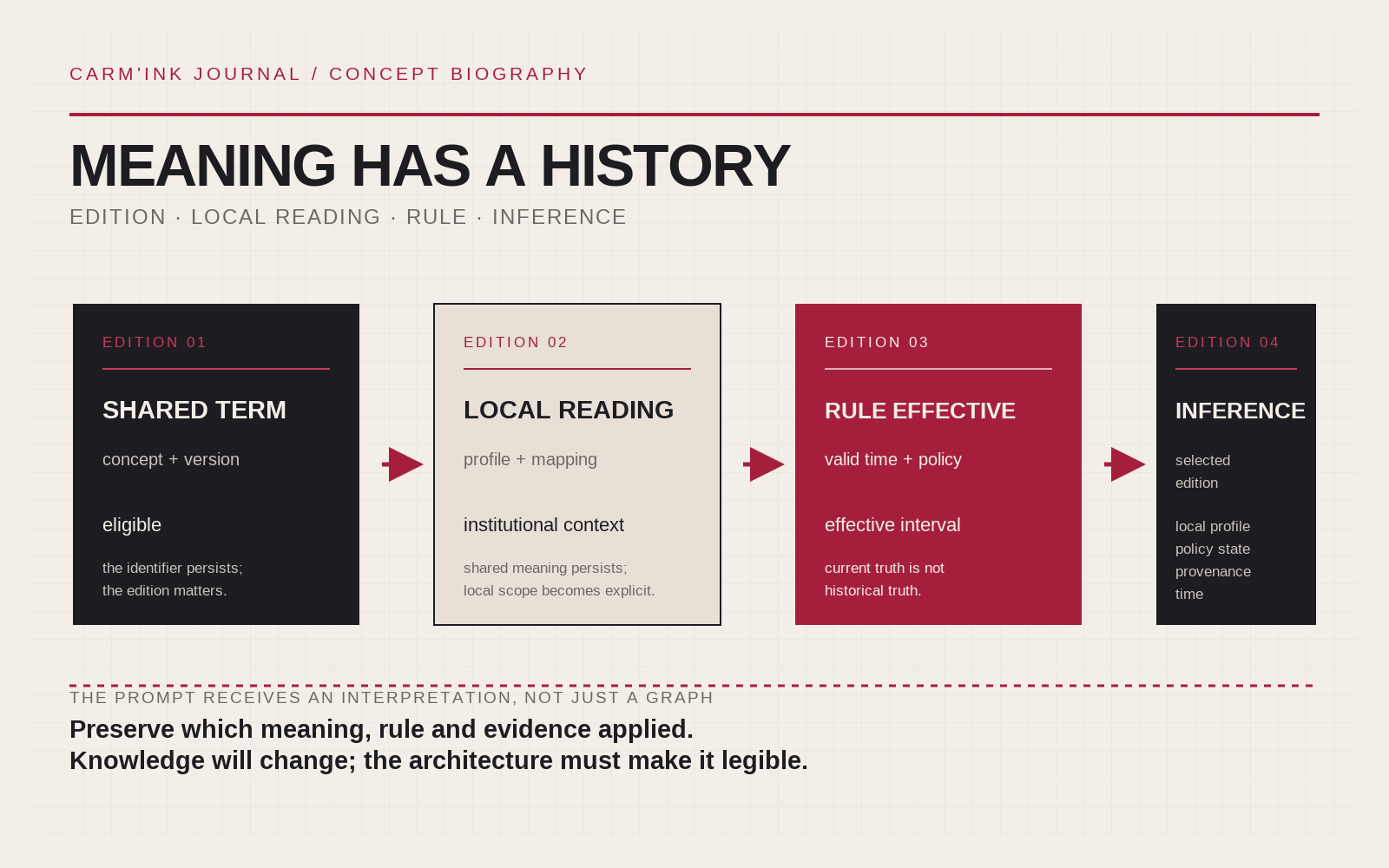
In the first edition of its knowledge model, eligible has a formal definition and a set of conditions. Records are classified against those conditions. The term has an identifier, a label and relationships to other concepts.
Then the institution adopts a local interpretation. A national vocabulary still supplies the shared meaning, but local policy adds a qualification. The term remains recognizable; its use has become more specific.
Later, the governing rule changes. New cases follow the revised rule from its effective date. Previously assessed cases may remain valid under the earlier rule, unless the institution explicitly decides otherwise.
Now an AI system is asked whether a case was eligible. The answer depends on more than the case record and the current definition. It depends on which version of the concept, local interpretation and rule applied to that case—and on the date the question concerns.
That is a small example of a wider architectural problem: meaning has a history, and inference needs to respect it.
Edition one: the shared term
An ontology provides a structured account of concepts and their relationships. It gives systems a way to refer to domain meaning beyond words alone.
But an ontology also changes. Concepts are refined, relationships are adjusted, and definitions are clarified. W3C’s OWL 2 specification provides a mechanism to distinguish versions in an ontology series: an ontology IRI identifies the series, while a version IRI identifies a particular version. Earlier versions can remain accessible by their version-specific identifiers. [1]
This makes a useful distinction possible:
- the concept identifier gives continuity across a model;
- the version identifier indicates which edition of the model was used.
The distinction matters when an inference must be reconstructed later. “The system used the ontology” is incomplete. Which edition? Which imports? Which local profile?
A version number alone is not a migration plan. It does not say whether a change is additive, incompatible or interpretive; which stored assertions need review; or whether past decisions should be reevaluated. Those are governance and engineering decisions around the ontology.
Edition two: the local reading
Shared vocabularies rarely contain every distinction needed in every institution. A local knowledge model may add terms, specialize a concept or map local language to a broader standard.
That local layer is productive. It lets organizations express their own domain knowledge while retaining links to shared semantics. It also creates a second version boundary: local interpretation can change independently of the global ontology.
A system therefore needs to distinguish at least three things:
- the shared concept and its version;
- the institution’s local extension or mapping;
- the rule that determines how the two are used together.
If a local meaning overrides a shared one, the scope of that override should be explicit. If both meanings apply in different workflows, the context should say which workflow selects which meaning. A bare label cannot carry those decisions.
The need to record change is recognized in knowledge organization itself. SKOS includes historyNote for significant changes in a concept’s meaning, form or state, and changeNote for more specific maintenance changes. [2] These notes help people understand a concept’s evolution. An AI architecture also needs the machine-usable version and provenance links that let retrieval and inference select the applicable interpretation.
Edition three: the rule takes effect
An institutional rule is not merely another definition. It can establish when a meaning applies, who approved it and whether it affects previous decisions.
This brings time into the semantic model.
Two time references are often relevant:
- Domain time: when a fact or rule was valid in the institution’s world.
- Record time: when the system learned, recorded or revised that fact.
Suppose a correction is entered in September but applies to a decision made in January. A question about what was true in January differs from a question about what the system knew in June. Without both time references, an AI system may silently substitute current knowledge for historical knowledge.
OWL-Time provides vocabulary for describing temporal entities, including instants and intervals. [3] It can help express when something begins, ends or overlaps with another interval. It does not decide whether a particular institutional rule is retroactive. That decision belongs to the institution’s governance and policy model.
This is where a current-state graph can mislead. A graph may show the latest relationship and still be unable to answer what relationship applied at a past date, or which version was available to the system at the time. “Current truth” and “historical truth” are different query contexts.
Edition four: the inference
When the system prepares context for a model, it should select a coherent semantic edition rather than combine every available definition as though they were interchangeable.
For the fictional eligibility question, that means resolving the relevant date, selecting the applicable policy, loading the correct local profile and retrieving evidence assessed under those conditions. If the dates conflict or the relevant version is unavailable, the system should expose that uncertainty or defer the answer.
The inference should retain enough provenance to explain its result. W3C PROV-O provides a model for linking entities, activities and agents—for example, recording which resources an activity used and which agent was associated with it. [4] Applied to AI systems, this supports a traceable account of the knowledge and semantic materials that informed an inference.
A useful inference record might identify:
- the ontology and local profile versions;
- the policy version and its effective interval;
- the evidence used and when it was recorded;
- the inference activity and the system or agents involved.
That record is not a guarantee that the answer is correct. It makes the interpretation inspectable and gives people a basis for reproducing or challenging it.
Change is part of the runtime
Semantic change has consequences beyond the knowledge graph itself. A new definition may affect mappings, validation rules, search indexes, cached context and the interpretation of earlier answers.
A production system needs a way to assess those effects. It should detect when a concept has been deprecated or narrowed, when a mapping no longer holds, and when an index or cached context still reflects an older edition. It should preserve historical versions where necessary and make migration decisions visible.
That does not mean every change requires retraining a model. Many semantic updates belong in the knowledge, policy and context layers: select the right edition, refresh dependent indexes, update mappings and make the applicable rule explicit before inference. Model changes may sometimes be needed, but they should not substitute for managing the semantics around the model.
The operational question is not only what does this concept mean? It is also:
Which authority defined it, in which edition, for which community, and during what interval?
The meaning that entered the prompt
A prompt is interpreted through the context assembled for it. If the ontology is current but the policy is old, if the local mapping is missing, or if the retrieval index still points to a superseded definition, the model may produce a fluent answer from an incoherent mixture of meanings.
Semantic intelligence therefore requires more than structured knowledge. It requires controlled evolution: versioned definitions, explicit local profiles, time-aware rules, traceable changes and context selection that preserves those distinctions.
The practical unit of inference is not a prompt paired with a graph. It is a prompt interpreted against a particular semantic edition, local context, policy state, evidence and time.
Knowledge will change. The architecture must make that change legible before a model turns it into an answer.
References
- W3C, OWL 2 Web Ontology Language Structural Specification and Functional-Style Syntax, section 3.3: Versioning of OWL 2 Ontologies.
- W3C, SKOS Simple Knowledge Organization System Reference, including concept change and history notes and its account of changes to SKOS semantics across versions.
- W3C, Time Ontology in OWL, 2017.
- W3C, PROV-O: The PROV Ontology, 2013.